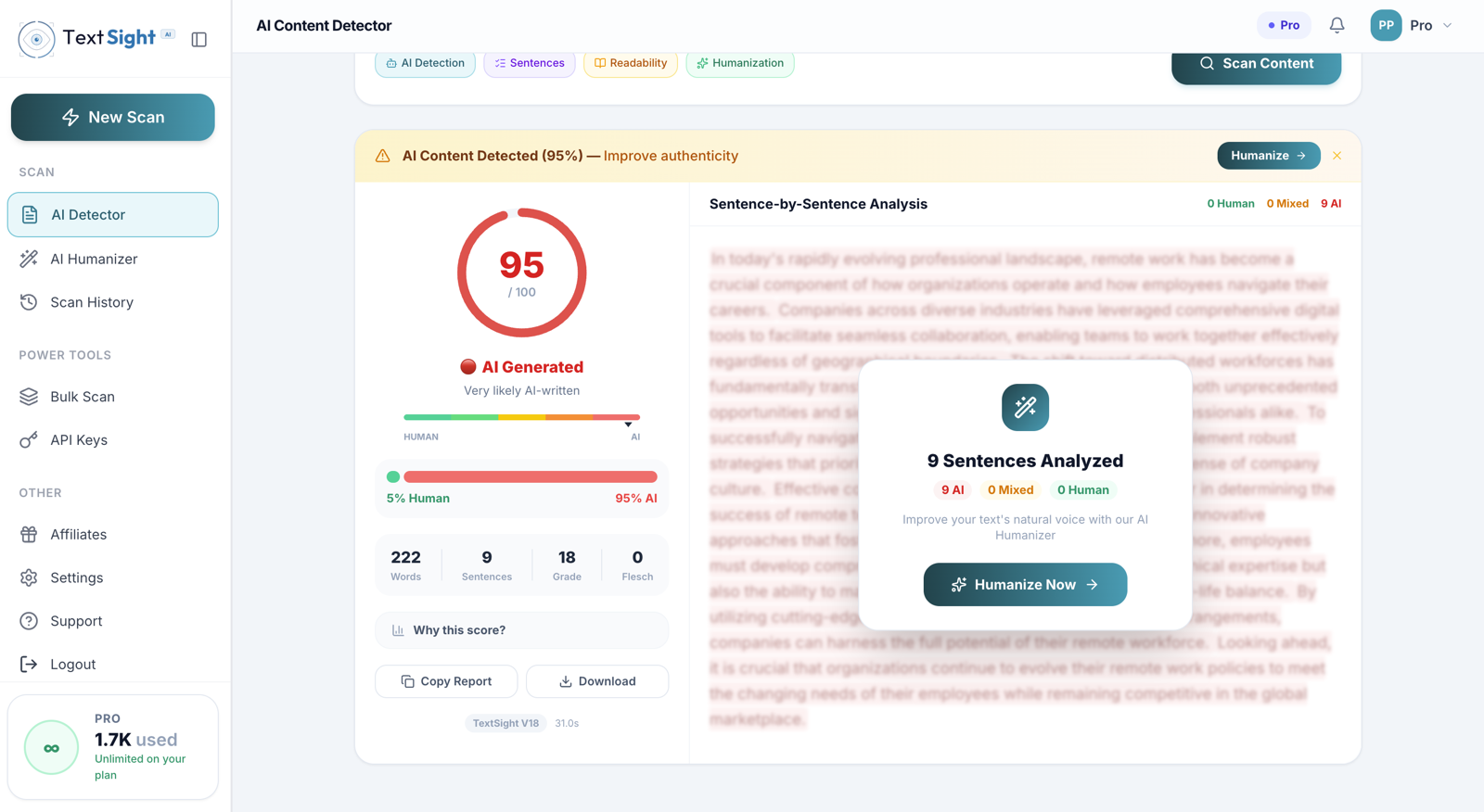
Paste any essay, article, email or report and see whether it was generated by an AI model — ChatGPT (GPT-5, GPT-4o), Claude (Opus 4.8, Sonnet 4.6), Gemini, DeepSeek, Grok, Llama or Mistral. Get an AI-likelihood score in seconds, with a per-sentence breakdown on Pro.
Paste some text or load the example to estimate AI likelihood.
Every scan returns a clear AI-likelihood score and a sentence-by-sentence breakdown — so you can see exactly which lines look AI-generated, not just a single number.
An AI content detector is a tool that estimates how likely a piece of writing was produced by an AI model — such as ChatGPT, Claude or Gemini — rather than by a person.
It works by reading the statistical fingerprint of the text: how predictable the word choices are, how much sentence length and rhythm vary, and how closely the structure follows the smooth, even patterns that language models tend to produce. From those signals it returns an AI-likelihood score — usually a percentage — rather than a simple yes or no.
An AI detector is not the same as a plagiarism checker. A plagiarism checker compares your text against existing published sources to find copied passages; an AI detector looks at how the text was written to estimate whether a machine generated it, even when every sentence is original. Many writers use both — one to confirm originality, the other to confirm human authorship.
Yes — but with real limits, and the honest answer is more useful than a marketing one.
On clear cases — a few hundred words of unedited AI text in English — a good detector is reliably accurate. The hard cases are short snippets, heavily edited or paraphrased text, and writing by non-native English speakers, whose more measured, template-like style can resemble AI.
That is exactly why TextSight reports a probability with a sentence-level breakdown instead of a guilty verdict, and why we are upfront that detection is tuned for English. Used as one signal alongside drafts, version history and a conversation with the writer, AI detection is genuinely useful. Used as sole proof of cheating, no detector on the market — including ours — is reliable enough.
TextSight analyzes writing patterns shared across the major large-language-model families — not just one vendor — so it generalizes across the current frontier of AI text generators. That means you can check output from a brand-new model the day it launches and still get a meaningful read, because the detector keys on how AI writes rather than memorizing one system.
The signals are model-agnostic, so newer and unreleased models still produce a useful estimate. Heavily edited or mixed human-and-AI passages are inherently ambiguous — treat the score as strong evidence to review, not absolute proof.
AI writing now turns up everywhere — student essays, job applications, emails, articles and filings. A fast verification step protects trust and quality.
Check student essays, theses, application materials and discussion posts before grading.
Verify cover letters, take-home assignments and written interview answers from candidates.
Screen guest posts, op-eds, press releases and freelance submissions for undisclosed AI use.
Audit agency deliverables, freelance copy and contributor articles to keep brand voice authentic.
Review contracts, statements, policy documents and submissions before they are relied on.
Get a quick second opinion on an email, message or document before you act on it.
Check briefs, drafts and freelancer deliverables before they publish, so the content that ships reads as original human writing.
Verify literature reviews, drafts and contributor sections, and keep submitted work demonstrably your own.
Every AI model leaves the same broad trace: writing that is fluent but unusually even. Before it returns a score, the detector breaks your text into the specific, measurable signals below, then weighs them together rather than leaning on any single tell.
AI writing leans on predictable word choices and smooth, low-surprise phrasing that reads evenly across a whole passage.
Human writing varies in cadence and length. Uniform sentence rhythm and balanced structure are common signals of generated text.
The free check returns an overall AI likelihood score; Pro and the app add per-sentence highlighting, exportable reports and unlimited daily scans.
Human writing carries a particular irregularity — the pace shifts, sentence lengths vary and word choices surprise. AI-generated text is smoother and more even-paced, because language models optimize for the most probable next word. The detector measures that difference across several dimensions:
The score combines these into a single AI-likelihood estimate, with per-sentence highlighting on Pro showing exactly which lines triggered the model.
Drop in an essay, article, assignment, report or email. No sign-up needed to run your first checks.
Your text is analyzed with the same model as the full TextSight app for AI-generation signals.
Get an overall AI-likelihood score and a plain-language verdict you can use as a prompt for review.
The line between "AI" and "human" is rarely clean. Most real-world writing sits somewhere on a spectrum, and the detector scores accordingly instead of forcing a yes-or-no verdict.
The detector returns an overall likelihood score and, on Pro, per-sentence highlights — so you can pinpoint which lines look AI-generated even when a document reads human overall. That makes it especially useful on mixed-authorship work.
No AI detector is 100% accurate, and TextSight is no exception. The score is an estimate, not a verdict — a signal for closer review rather than proof of authorship.
For high-stakes decisions — academic integrity, hiring, publication — always pair the result with human judgment and a conversation with the writer.
The detection category is crowded, and the right tool depends on your use case. Here is where TextSight fits.
Where TextSight stands out: it pairs detection with a readable signal breakdown and per-sentence highlighting on Pro, so you get more than a verdict — you get the reasoning behind it. As with every detector, treat results as evidence to review, not proof.
TextSight's AI detection is built and tuned for English. That is where it is accurate and where we recommend relying on it.
Need other languages? TextSight's writing tools — the humanizer, summarizer and translator — support 50+ languages. AI detection, specifically, is English-first by design.
Your text stays yours. Here is exactly what happens to it.
The score is a starting point for a decision, not the decision itself. A few habits make it far more reliable.
Used this way, the detector becomes a fast triage tool — it tells you where to look, so you spend your attention on the passages that actually need it.
No single phrase proves anything on its own, but a few patterns show up again and again in AI-generated writing. Once you know them, you can spot likely AI text before you even run a check.
These are hints, not proof — plenty of careful human writing shares some of them. The detector exists precisely because eyeballing alone is unreliable: it weighs many signals at once instead of one or two giveaways.
Detectors sometimes flag genuinely human writing — especially short, formal or non-native English text. If that happens to you, a score is not a verdict, and you have ways to show your work.
We are deliberate about this: TextSight reports an AI-likelihood estimate, never a guilty verdict. For any high-stakes decision, the score should support human judgment, not replace it.
Open the full Detector in the app for per-sentence highlights, exportable reports, bulk scanning and unlimited daily scans.
Open the full DetectorCatch fabricated facts, fake citations and made-up claims in ChatGPT, Claude or Gemini output.
AI Voice Detector →Upload audio and check whether a voice is real or AI-generated (ElevenLabs, OpenAI TTS, Murf, PlayHT).
AI Image Detector →Check whether a photo or graphic was generated by AI tools like Midjourney, DALL·E or Stable Diffusion.
AI Code Detector →Detect whether code was written by GitHub Copilot, Cursor, Claude Code or ChatGPT.
The signals behind every AI-likelihood score, explained in plain language.
AI detector false positives →Why human writing sometimes gets flagged, and how to read a score fairly.
Turnitin AI detector accuracy →How school detectors actually perform, and what the numbers really mean.
ChatGPT detector →Check specifically whether a passage was written by ChatGPT.
AI detector for college →What students and instructors should know about checking essays.
Best AI detector in 2026 →How the leading AI detectors compare this year.
A plain-English primer on how detection works and what the score really means.
Can Turnitin detect ChatGPT? →What school detectors can and can't catch in 2026, and how to read the result.
ChatGPT vs Gemini vs Claude: detection →How text from the major models compares when you run it through a detector.
AI detection for teachers →A practical, fair approach to using AI detection in the classroom.