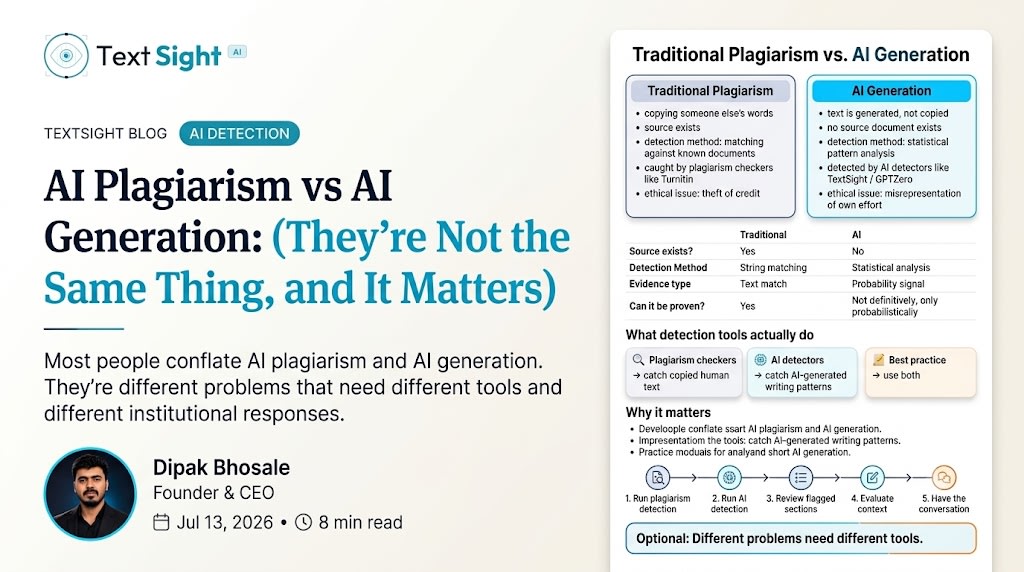
Ask ten people what "AI plagiarism" means and you'll get ten different answers. Some think it means copying text that an AI produced. Some think it means using AI to generate text and submitting it as your own. Some think plagiarism detection tools catch it automatically. Most are wrong about at least one of those things.
The confusion is creating real problems. Universities deploying plagiarism checkers expecting them to catch AI generation. Content platforms checking for AI generation without checking for copied human text. Educators treating two distinct integrity issues as interchangeable.
Here's the actual difference, why it matters, and what you need to do about it.
Traditional Plagiarism: The Matching Problem
Traditional plagiarism is copying someone else's words and presenting them as your own. The defining feature: there's a source. Someone wrote it first. You copied it.
Plagiarism detection works by matching. Turnitin maintains a database of academic papers, published articles, websites, and student submissions. When you submit a document, it's compared against that database. A high similarity score means significant text overlap with existing sources.
This is string matching at scale. Find the same sequence of words in two places, flag it. The technology has gotten sophisticated — it handles paraphrasing, rearranged sentences, translated text — but the fundamental approach is: compare this document to documents that already exist.
It works. It works well for traditional plagiarism because the source material exists and can be found.
AI Generation: The Originality Problem
AI-generated text isn't copied from anywhere. GPT-5 doesn't have a database of sentences it pastes together. It generates statistically probable continuations of text based on patterns learned from training data. Every output is, in a technical sense, original — no source document exists that matches it.
Run an AI-generated essay through Turnitin's plagiarism checker. The similarity score will be low. Maybe zero. The essay wasn't copied — it was generated. There's nothing to match against.
This is the fundamental mismatch that trips up institutions that bought a plagiarism checker and assumed it covered AI generation. It doesn't. These are different problems.
AI detection works by looking at statistical properties of the text itself, not by matching it against other documents. The signals include:
- Perplexity: How predictable is the text? AI-generated text tends to be more predictable — it makes the statistically safe word choices more often than a human writer would.
- Burstiness: How much does complexity vary? Human writing has higher variance. Some sentences are simple, some are complex. AI writing tends toward a more consistent complexity level.
- Token distribution: What words appear in what patterns? AI models have characteristic vocabulary preferences — certain transition phrases, certain hedging language, certain structural patterns — that appear more frequently than in human writing.
- Sentence structure patterns: AI models tend to produce sentences of similar syntactic structure in sequence, where humans vary structure more naturally.
None of these is a definitive signal alone. Combined, they produce a probabilistic assessment — not certainty, but a well-calibrated likelihood. That's what TextSight's Humanization Score represents: a 0–100 measure of how human these statistical patterns look.
The Ethical Distinction
This matters ethically, not just technically.
Traditional plagiarism is theft of credit. Someone worked to produce something. You took it and claimed it was yours. The injury is to the original author — you've appropriated their intellectual labor.
AI generation is different. When you use GPT-5 to write an essay and submit it as your own, nobody's words were stolen. The machine doesn't have a stake in the work. The integrity violation is something else: misrepresentation of your own effort and ability. You're claiming to have done intellectual work that a machine did for you.
These are both dishonest. But they're dishonest in different ways and they call for different responses.
Traditional plagiarism requires finding the source and the copying. The evidence is text-match similarity. The severity scales with how much was copied.
AI generation requires demonstrating that the writing was machine-produced. The evidence is statistical. The severity question is more complicated — how much genuine intellectual work did the student contribute, even if AI handled the drafting?
An institution that only punishes traditional plagiarism and ignores AI generation has an integrity gap. An institution that conflates the two will treat AI generation as if it's "copying from a machine" and misunderstand what detection tools can and can't show.
What Detection Tools Actually Do
Let's be clear about what each category of tool does:
Plagiarism checkers (Turnitin, Copyleaks plagiarism mode, iThenticate):
- Match text against existing documents
- Effective at: catching copied human text
- Not effective at: detecting original AI-generated text
- False positive risk: Low for AI-generated text (they won't flag it)
- False negative risk: High for AI generation (they'll miss it entirely)
AI detection tools (TextSight, GPTZero, Originality.ai):
- Analyze statistical properties of text
- Effective at: identifying AI-generated text patterns
- Not effective at: matching text against human sources
- False positive risk: Moderate (human writing that happens to be formal or structured may score lower)
- False negative risk: Moderate for heavily edited AI text
These tools solve different problems. A university that only runs plagiarism detection is blind to AI generation. A platform that only runs AI detection is blind to copied human text.
The complete writing integrity check uses both.
The Comparison Table
| Factor | Traditional Plagiarism | AI Generation |
|---|---|---|
| Source exists? | Yes — identifiable source document | No — text is generated, not copied |
| Detection method | String matching against database | Statistical pattern analysis |
| What gets flagged | Similarity to known text | Probability distribution of the text |
| Turnitin catches it? | Yes | Usually no |
| GPTZero catches it? | No | Yes (with caveats) |
| TextSight catches it? | No | Yes — Humanization Score |
| Ethical violation | Theft of credit from original author | Misrepresentation of own effort |
| Institutional response | Cite the source found | Statistical evidence + conversation |
| Can it be "proven"? | Yes — show the matching text | No — only probabilistic evidence |
The last row is important. Traditional plagiarism can be proven — you can show the source side by side with the submission. AI generation cannot be proven in the same way. Detection tools produce probabilistic evidence, not proof. This distinction matters enormously for how institutions should respond.
The Practical Implications
For students
Understand that using AI to write your assignments triggers AI detection tools, not plagiarism checkers. If your school uses both (and many do), you're being checked for both problems simultaneously — but with different tools.
If you use AI assistance in your writing process, running your work through TextSight before submission tells you what AI detection sees. A Humanization Score above 75 means most AI detectors won't flag it. Below 60 means the statistical patterns are visible enough to draw attention.
The AI Vocabulary Highlighter shows you exactly which phrases look machine-generated. Fix those specific passages and rescan.
For educators
Using only Turnitin doesn't cover AI generation. You need both a plagiarism checker and an AI detection tool. They do different things.
When you suspect AI generation, remember that detection scores are probabilistic. A Humanization Score of 45 or a GPTZero flag doesn't constitute proof — it's a signal that warrants further investigation, not an open-and-shut case. Use detection scores to decide whether to investigate, not as evidence in a proceeding.
The most reliable additional evidence: in-person conversation. Students who wrote their own work can discuss it. Students who submitted AI output they didn't engage with often can't.
For institutions
Policy language matters. "No plagiarism" and "no AI generation" are different rules. Your honor code should address them separately. The evidence standards are different, the detection methods are different, and the ethical framing is different.
If your plagiarism policy was written before 2023, it almost certainly doesn't adequately address AI generation. Review it.
Where Things Get Complicated
Some scenarios don't fit neatly into either category:
AI-assisted writing: A student uses AI to generate a first draft, then substantially rewrites it. They've used AI, but they've also done significant intellectual work. This doesn't fit the traditional plagiarism model (nothing was copied) or the simple AI generation model (the student genuinely engaged with the material).
Human text that looks like AI: Formal, structured, consistent writing can score low on AI detection tools — not because it's AI-generated, but because it exhibits some of the same statistical properties. This is why false positives are a real problem and why detection scores shouldn't be treated as proof.
AI-generated paraphrasing of human sources: If a student uses AI to paraphrase a source rather than copying it directly, they've done something that neither a plagiarism checker nor an AI detector will necessarily catch well. The plagiarism checker won't see high similarity (it's paraphrased). The AI detector will see AI patterns (it was generated). But the underlying issue — failure to engage with sources honestly — isn't fully captured by either tool.
These edge cases reinforce the core point: detection tools are investigative aids, not adjudicators. They tell you where to look. They don't tell you what happened.
A Complete Writing Integrity Workflow
For anyone who needs to assess writing integrity comprehensively — educators, editors, content managers — here's what using both tool types looks like:
-
Run plagiarism detection first. High similarity scores against existing sources are the clearest integrity signal. If there's direct copying, that's your finding.
-
Run AI detection. Use TextSight for a Humanization Score. Use a second tool (GPTZero, Originality.ai) for comparison. Note whether both tools agree or disagree — disagreement means the signal is ambiguous.
-
Look at what's flagged. Which sections? The literature review? The argument development? The conclusion? Patterns are informative. A paper where only the summary sections look AI-generated tells a different story than one where the original analysis reads as AI-generated.
-
Evaluate the whole picture. Detection scores, assignment context, submission history, student's demonstrated abilities. No single signal is definitive.
-
Have the conversation. For consequential decisions, the most reliable evidence comes from asking the student to explain and defend their work in person.
The tools have gotten good enough to be useful. They haven't gotten good enough to replace judgment. Understanding what each tool actually measures — and what it doesn't — is the foundation of using them well.
Related reading:
- Can Turnitin Detect ChatGPT in 2026?
- What Is AI Content Detection?
- An Honest Review of the AI Detector Market in 2026
- GPTZero vs Turnitin vs TextSight 2026
Try it on your own writing