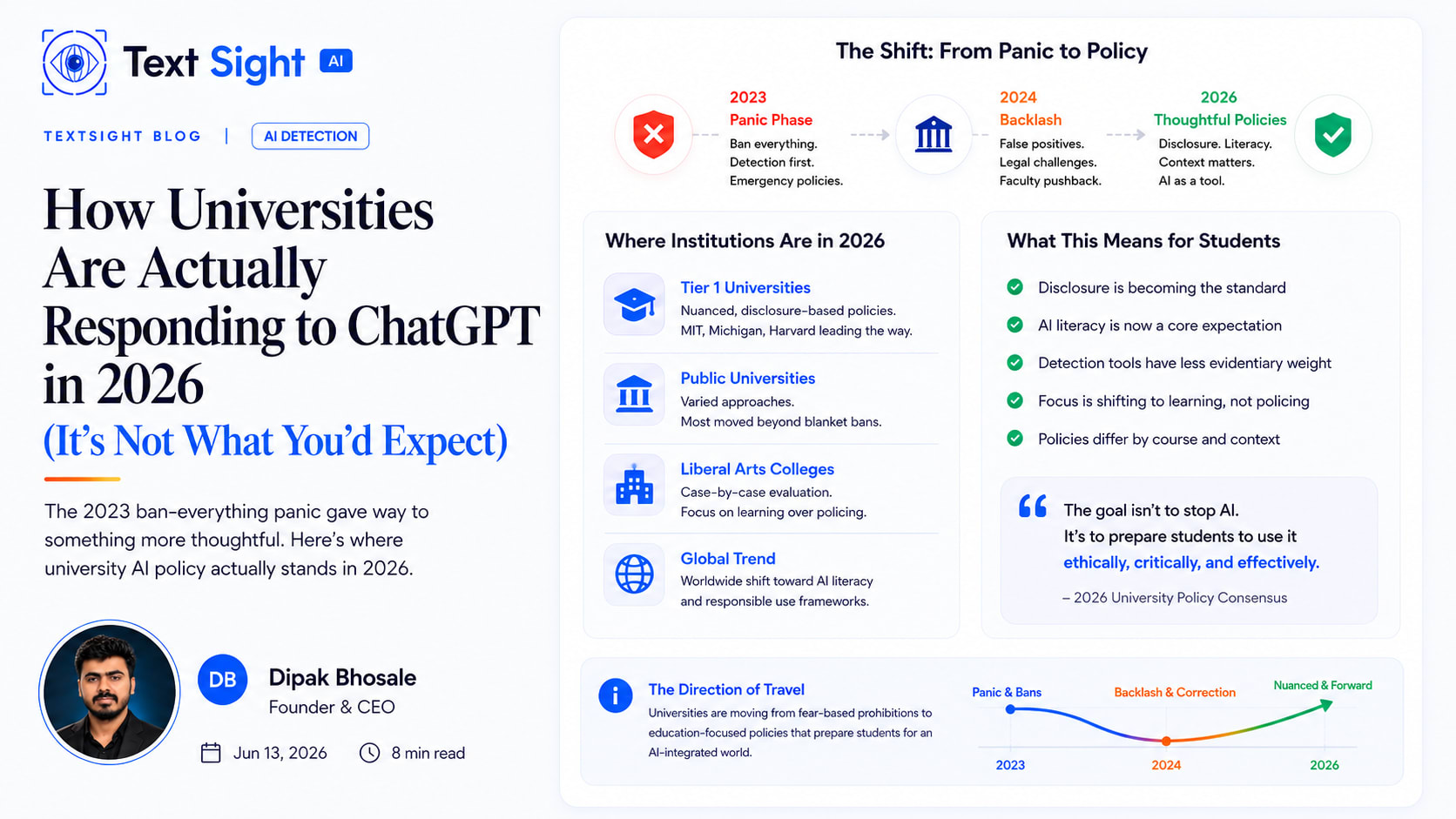
In late 2022, ChatGPT launched and academia collectively panicked. Within three months, hundreds of institutions had issued emergency AI policies. Most of those policies said roughly the same thing: AI-generated text is prohibited, period. Submit it and face academic discipline.
That moment was understandable. Nobody knew what was coming. The tool was genuinely disruptive and institutions had no framework for it.
But it's 2026 now. Three and a half years later. The landscape looks completely different — and not in the direction most people assume. The story isn't "universities got stricter." It's more complicated, and honestly more interesting.
The 2023 Panic Phase
Let me document what actually happened, because it's useful context.
Between January and June of 2023, more than 400 colleges and universities in the United States issued some form of AI prohibition. Many of these were emergency policy updates — blanket bans with no distinction between assignment types, no guidance on AI-assisted research versus AI-generated text, no clear enforcement mechanism.
Detection became the enforcement strategy. Turnitin's AI detection tool, launched in April 2023, was rapidly adopted — by the company's own figures, over 6,000 institutions signed up within the first year.
The problems showed up quickly.
A widely-cited 2024 Stanford HAI report found that Turnitin flagged 19% of essays written by TOEFL test-takers as AI-generated. These were essays submitted by human test-takers to demonstrate English proficiency — not AI, not assisted writing, just human writing from non-native speakers that happened to score as statistically low-perplexity. The false positive rate for Native American students was even higher — some studies found it reaching 30% or above.
The legal consequences started arriving in 2024. A student at Georgia Tech filed suit after failing a course based on a Turnitin AI flag that the student disputed. Similar cases were filed at two large UK universities. In Washington State, after documented evidence of 1,485 false positives in a single semester, the state's higher education board terminated its Turnitin AI detection contract outright in late 2024.
Yale faced a class-action filing in early 2025 from 23 students who claimed their grades were negatively affected by AI detection flags on work they had written themselves. The case was settled out of court for undisclosed terms, but Yale revised its policy substantially within 60 days of the filing.
The panic response was creating legal and ethical problems faster than it was solving the AI problem.
The Overcorrection Backlash
By mid-2024, the narrative had shifted.
Mainstream coverage started featuring stories of students being accused of cheating based on AI detection tools alone — without supporting evidence, without a chance to appeal, without a clear process. The New York Times ran a widely-shared piece in July 2024 titled "The Turnitin Problem," featuring three students who had been disciplined for AI use based on detector scores that, when examined by independent researchers, were almost certainly false positives.
Faculty started pushing back internally. At several large research universities, faculty senate votes explicitly prohibited using AI detection tool scores as the sole basis for academic integrity investigations. The American Historical Association and the Modern Language Association both issued statements in 2024 cautioning against over-reliance on detection technology.
The practical effect: AI detection tools didn't disappear, but the evidentiary weight institutions gave them dropped dramatically. By 2025, most institutions with active AI integrity policies required corroborating evidence before proceeding with formal charges based on AI detection flags alone.
This was probably the right correction. But it left a vacuum.
Where Institutions Actually Are in 2026
The current landscape is more varied than any single narrative captures, but a few clear patterns have emerged.
Tier 1 Research Universities: Nuanced, Disclosure-Based Policies
The most sophisticated institutions have moved toward policies that distinguish between types of AI use, require disclosure rather than prohibition in many contexts, and build AI literacy into the curriculum rather than fighting AI as an external threat.
MIT's 2026 policy framework separates AI use into four categories: Prohibited (submitting AI-generated work as your own in assessed writing), Permitted with Disclosure (using AI for drafting when the course permits it), Permitted Without Disclosure (grammar assistance, research summarization, brainstorming), and Required (several MIT courses now explicitly require AI tool use as part of the curriculum).
The University of Michigan has gone furthest on the disclosure model. Since fall 2025, every major submission at Michigan includes a standardized AI Use Declaration — a brief statement indicating the role AI played in the work. Options range from "No AI use" to "AI-drafted with substantial revision." The declaration is part of the graded submission. Misrepresenting your AI use on the declaration is the new form of academic dishonesty — a more honest framing of what the underlying concern always was.
Harvard's approach, effective since January 2026, is course-by-course permission. Each faculty member specifies at the start of term whether AI use is permitted for that course's assignments, and in what form. The institutional policy sets a floor (no AI without disclosure) but gives individual courses flexibility above that. This is probably the most common approach among research universities right now.
Regional Universities and Liberal Arts Colleges: More Varied
Smaller institutions have moved more slowly, partly from resource constraints and partly from different campus cultures. Many are still running modified versions of their 2023 emergency policies.
The characteristic failure mode here is policies that prohibit AI use explicitly but provide no enforcement mechanism and no guidance on borderline cases. These create situations where the rule exists but nobody is quite sure what it means — which is almost worse than having no rule.
Professional Schools: Stricter, For Good Reason
Law schools, medical schools, and education programs have generally maintained stricter policies, and this is defensible. The assessed skills in these programs — legal analysis, clinical reasoning, pedagogical judgment — need to be demonstrably present in the student. A lawyer who can't analyze a case without AI assistance isn't qualified. A doctor who can't reason through a differential without AI support isn't ready to practice. The professional context makes the demonstrated skill matter in a way it doesn't for a general education history course.
Most law schools in 2026 still prohibit AI drafting on substantive writing assignments. Some have carved out permitted uses for research and cite-checking. Medical schools are still largely in prohibition mode for clinical write-ups, while allowing AI for research synthesis.
AI Literacy as the New Institutional Goal
Here's the shift that I think matters most and gets the least attention: leading institutions have stopped treating AI as a problem to be suppressed and started treating AI literacy as a graduation requirement.
Stanford's "Human-Centered AI" course, once an elective, became a graduation requirement in the humanities division in fall 2025. The course explicitly covers how to work with AI tools while maintaining intellectual integrity, how to evaluate AI outputs critically, and how to disclose and document AI assistance in academic and professional work.
Georgetown requires all students in its School of Foreign Service to complete a module on "AI in Professional Contexts" that covers detection technology, policy disclosure, and the ethics of AI-assisted writing for diplomatic and government work.
This framing — AI literacy as a skill to develop, not a threat to suppress — is the most productive institutional response to the technology. It acknowledges that students will use AI throughout their careers and need to know how to use it responsibly, rather than pretending the skill isn't needed.
What This Means for Students Right Now
The practical picture in 2026: you cannot assume your institution's 2023 AI policy still applies without checking. Many schools have updated policies in the last 18 months, and the updates tend to be more permissive in some areas and more precise in others.
Read your course syllabus for AI policy language — faculty now typically include this. If it's absent, ask. The question itself is evidence of good faith.
Understand that disclosure-based approaches are the direction academia is moving. Getting comfortable with transparency about AI use — what you used, how, what you contributed — is a professional skill that will matter well beyond college.
Don't rely on detection technology as your guide. Whether you used AI or not, detector scores are inconsistent enough that a false positive is a real possibility. Running your own text through a tool like TextSight before submission lets you understand your risk profile before someone else makes it a problem.
The Turnitin Question Specifically
Turnitin is still the most widely deployed detection tool, despite the documented false positive problems and the Washington State contract termination. It's worth knowing where it stands.
Following significant reputational damage from the false positive coverage, Turnitin rolled out "Confidence Scores" in their AI detection output in mid-2025 — a lower/medium/high reliability rating alongside the AI percentage. This was an implicit acknowledgment that their tool's accuracy was context-dependent. Many institutions updated their policies to act only on "high confidence" flags, which effectively raises the bar for investigation.
The AI percentage Turnitin reports should not be treated as a grade. A 73% AI flag with "medium confidence" means something different from an 89% flag with "high confidence" on a short assignment. Students who understand this are better positioned to challenge wrongful findings.
The Direction of Travel
If you're trying to predict where university AI policy will be in another two years, the pattern is fairly clear. Blanket prohibition is giving way to contextual permission. Detection-only enforcement is giving way to disclosure-and-investigation-as-evidence. The institutional conversation has shifted from "how do we stop AI use?" to "how do we assess whether students are developing the skills they need?"
That's a better question. It took three years of false positives, lawsuits, and policy chaos to get institutions to ask it, but it's the right question.
And the students who navigate this best will be the ones who understand the technology — what detectors are measuring, what AI use is actually assessed to represent, and how to be honest about their own process. That combination of technical literacy and intellectual honesty is what the best 2026 AI policies are trying to cultivate. The worst policies still just say "don't."
Related reading:
- Is Using AI in College Actually Cheating?
- Can Turnitin Detect ChatGPT?
- My Essay Was Flagged as AI But I Wrote It
- How to Avoid AI Detection as a Student
Try it on your own writing